
Plants
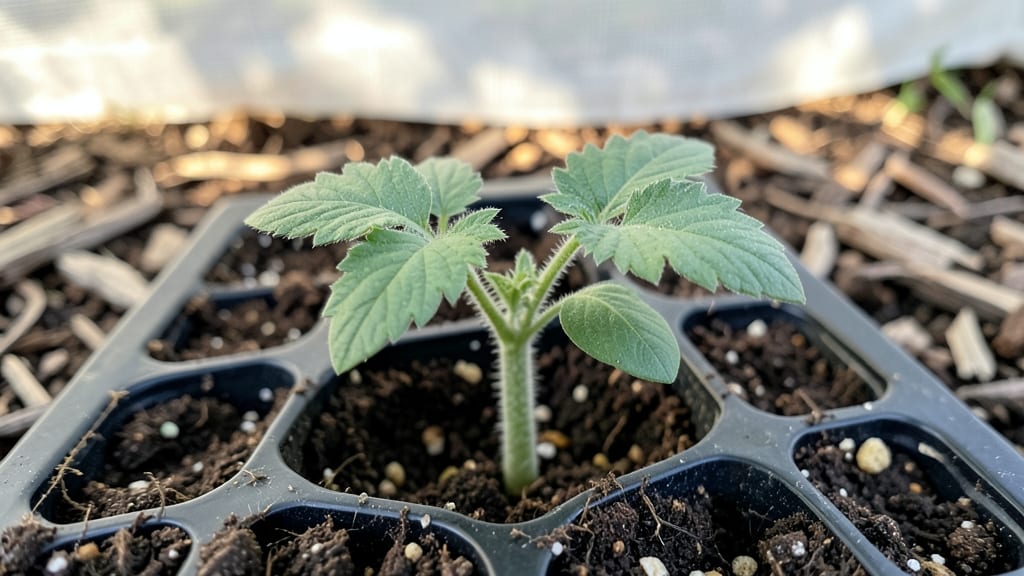
Cherry tomato sprouts look like tiny white roots first, then develop into small oval cotyledons that open into miniature tomato leaves with fine hair-like stems and a faint green tint.
When you first spot cherry tomato sprouts, you'll notice their delicate white roots peeking through the soil, almost like tiny hairs. 🌱 These roots anchor the seedling while the plant's first true leaves—called cotyledons—emerge as small, rounded shapes that eventually unfold into leaves resembling miniature versions of mature tomato foliage.
The leaves typically start with a pale green hue before deepening in color as they mature, and the stems often have a fuzzy texture that helps identify them as young tomato plants.
The early stages of growth are particularly delicate, so it's important to handle them gently to avoid damaging the fine stems. Once the cotyledons fully open, you'll see the classic tomato leaf shape, though much smaller—about the size of a dime.
This transformation happens within 7-14 days under ideal conditions, depending on temperature and moisture levels.
💡 In This Article
- Stages of Cherry Tomato Seedling Development
- Identifying Healthy vs. Damaged Cherry Tomato Sprouts
Stages of cherry tomato seedling development
The very first sign of life appears when the seedling pushes through the soil as a delicate white root—often just 1/16-inch thick—that resembles fine hair strands.
These primary roots anchor the seedling while secondary roots begin branching out within 3-5 days of germination, creating a small white network that looks like a tiny spiderweb. This root system is crucial because it absorbs water and nutrients while the plant is still too small to photosynthesize effectively.
Next come the cotyledons, the seedling's first true leaves, which appear as small, oval-shaped green buds about 1/8-inch long and 1/16-inch wide. These initial leaves are actually the plant's seed leaves, not true foliage, and they typically unfold within 5-7 days after root emergence.
Their color starts as a pale, almost translucent green before deepening to a richer hue as chlorophyll production ramps up. The edges of these cotyledons often have a slightly serrated texture, giving them a miniature version of a tomato leaf's jagged outline.
Once the cotyledons fully open, the real transformation begins: true leaves emerge in clusters, each about 1/4-inch to 1/2-inch wide and shaped like tiny, lobed versions of mature tomato leaves. These leaves develop a darker green color and a slightly waxy coating that helps retain moisture.
What makes them distinctive is the fine, hair-like trichomes along the stems and leaf edges—a characteristic feature of tomato plants that helps identify them at this early stage.
This entire process from root emergence to true leaf formation typically takes 10-14 days under ideal conditions of 70-75°F soil temperature and consistent moisture.
Here's what's happening biologically: The seedling relies on stored energy from the seed during the first few days, but once the cotyledons emerge, photosynthesis begins in earnest. The true leaves contain more chlorophyll than the cotyledons, allowing the plant to produce its own energy.
This shift is critical because it marks the transition from a seed-dependent stage to an independent, self-sustaining growth phase. 🌱 During this time, the stem also thickens slightly, becoming less fragile and more capable of supporting the plant's increasing weight as it grows.
One fascinating detail is how the timing of these stages can vary based on environmental conditions.
For example, cooler temperatures (60°F) can slow root development by up to 30%, while excessive heat (> 85°F) may cause the cotyledons to unfold too quickly, making them more susceptible to damage.
The fine hair-like trichomes on the stems also serve a protective function, reducing water loss and shielding the young plant from pests—a natural defense mechanism that becomes more pronounced as the plant matures.
To visualize this process, imagine holding a magnifying glass over a seedling tray: The roots look like tiny white threads, the cotyledons resemble oversized freckles on the soil surface, and the true leaves appear as miniature versions of the lush foliage you'd see on a mature tomato plant.
This progression from root to leaf is what makes cherry tomato sprouts so captivating to watch—it's a living example of how plants transition from complete dependence to self-sufficiency in just a few weeks. ✨