
Companion Plants
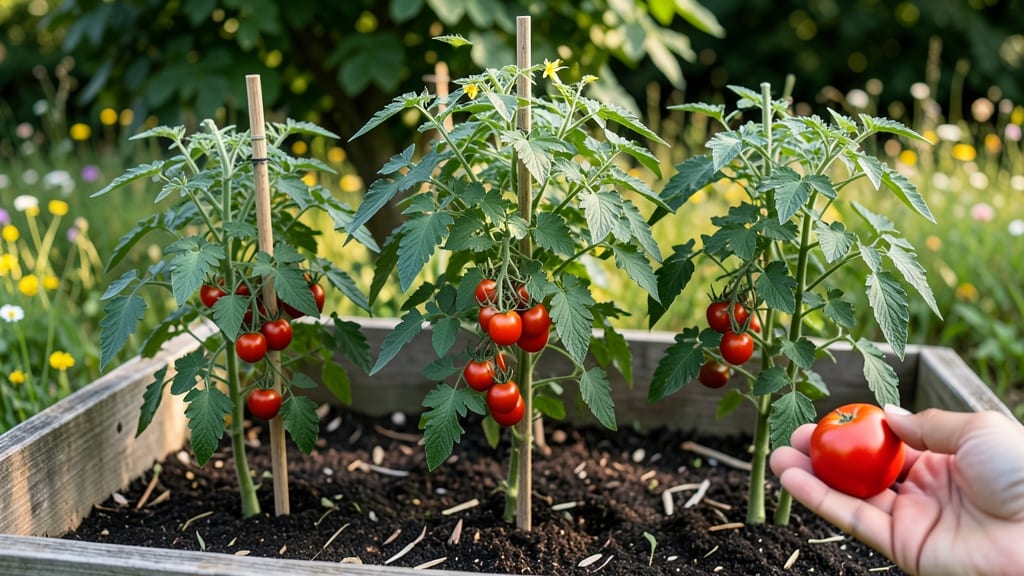
To determine how many cherry tomato plants per person you need, aim for 2–4 plants per adult in small gardens, as they produce abundant fruit while fitting neatly into tight spaces. Dwarf varieties require less room, while sprawling types may need pruning to stay contained.
Cherry tomatoes are prolific producers, so even a few plants can feed a family for weeks. 🌱 A single indeterminate plant can yield 20–30 pounds of fruit per season, while dwarf varieties produce 5–10 pounds but in a more compact footprint.
The key is matching plant type to your space—containers work well for 1–2 plants, while in-ground beds can handle 4–6 plants per person if spaced properly. I always recommend starting with 2 plants per adult to avoid overcrowding while ensuring a steady harvest.
For small gardens, consider vertical growing or companion planting to maximize space efficiency. 🌿 Cherry tomatoes pair well with basil, marigolds, and onions, which can help deter pests while creating a thriving micro-ecosystem.
If you're short on ground space, trellising indeterminate varieties can save room while improving airflow, reducing disease risk.
💡 In This Article
- Cherry Tomato Yield Math: How Many Plants Feed a Family
- Small-Space Cherry Tomato Planting Strategies
Cherry tomato yield math: how many plants feed a family
Cherry tomatoes are powerhouses of productivity, with yield differences between varieties that can dramatically impact your planting math.
A single indeterminate plant—like 'Sweet 100' or 'Sun Gold'—can produce 20–30 pounds of fruit per season when given proper care, while dwarf varieties such as 'Tiny Tim' or 'Patio Princess' yield 5–10 pounds but in a 12-inch diameter footprint.
The reason for this disparity lies in their growth habits: indeterminate types grow continuously, producing fruit all season long, while determinate types set all their fruit at once before dying back. 🌱
Space requirements vary just as widely. Indeterminate plants need 18–24 inches of space per plant in-ground, but can be trellised to reduce their footprint by 50% or more. Dwarf varieties thrive in 12-inch pots or spaced 12 inches apart in containers, making them ideal for balconies or windowsills.
For a family of four, two indeterminate plants (yielding 40–60 pounds total) would provide a steady supply of 1–2 cups per person per week during peak season, while dwarf varieties would require 4–6 plants to match that yield.
Your garden layout directly impacts how many plants you can fit. In-ground beds allow for closer spacing (18 inches for indeterminates, 12 inches for dwarfs), while containers require slightly more distance (24 inches between plants) to prevent root competition.
Vertical trellising can double your effective space by training vines upward, but this requires 6–8 feet of vertical clearance. I've found that a 4-foot by 8-foot raised bed can comfortably hold 6–8 indeterminate plants when spaced 18 inches apart, producing enough for a family of four with minimal waste.
Consider your harvest goals when calculating plant numbers. If you're growing primarily for fresh eating, 2–3 plants per person provides a generous supply without overwhelming your space. For canning or preserving, aim for 4–6 plants to ensure you have enough fruit at peak ripeness.
The key is balancing yield with your available space—overcrowding leads to smaller fruits and increased disease risk, while too few plants may leave you wanting more during peak harvest weeks. 🍅
Don't forget about succession planting. If you're in a short-season climate, stagger your plantings by 2–3 weeks to extend your harvest window. This means planting 2–3 additional plants every few weeks in early spring, rather than all at once.
For example, in Zone 5, I plant my first round in late May, followed by two more in early June—this ensures a continuous supply from July through September without needing excessive space at any one time.
For those with limited space, prioritize high-yielding varieties like 'Super Sweet 100' (indeterminate) or 'Tumbling Tom' (dwarf). These produce 20% more fruit than average varieties while maintaining compact growth habits. The trade-off is slightly smaller tomatoes, but the volume makes up for it—perfect for snacking or adding to salads.
Always check the plant tag for specific yield estimates, as some hybrid varieties are bred specifically for high productivity in small spaces.