
Pests
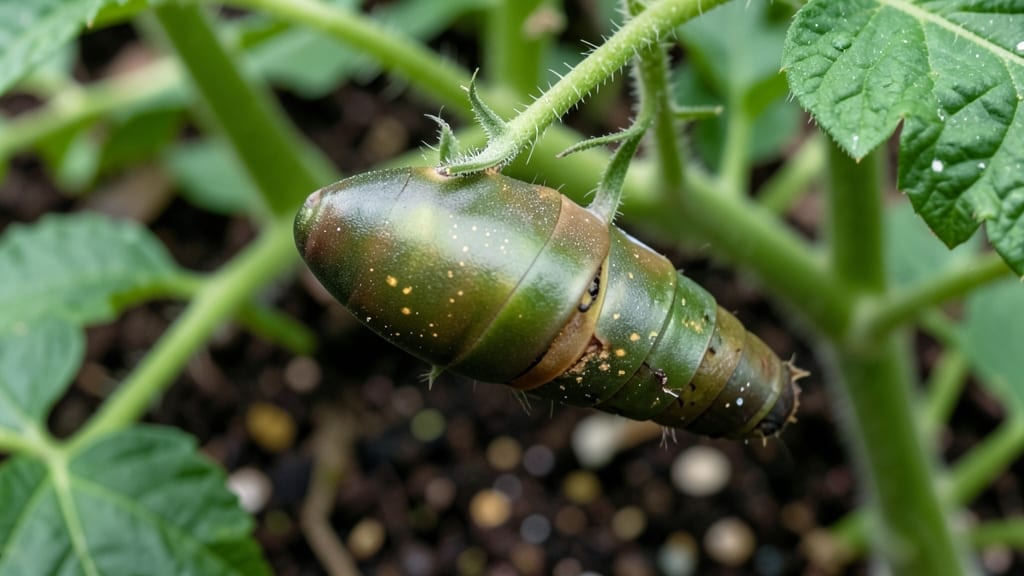
A tomato caterpillar, or tomato hornworm, turns into a sphinx moth (Manduca sexta) after pupating in soil, completing its life cycle in about 4-6 weeks. These moths play a key role in pollination before dying shortly after laying eggs on tomato plants.
A tomato caterpillar's transformation is one of nature's most fascinating cycles. 🌱 After devouring tomato leaves as voracious larvae, these caterpillars burrow into the soil to form a hard chrysalis, emerging weeks later as striking green-and-black sphinx moths.
Their rapid life cycle—just 4-6 weeks—means gardeners often see multiple generations each season. What's surprising is how these moths contribute to ecosystems: their long proboscis helps pollinate night-blooming flowers, even though they're primarily nocturnal fliers.
The adult sphinx moths live only about a week, focusing all their energy on mating and laying eggs. This short lifespan explains why gardeners rarely spot them—they're mostly active at dusk or dawn.
Understanding this cycle helps gardeners time interventions effectively, like removing caterpillars before they pupate, while still appreciating their ecological role.
💡 In This Article
- Tomato Hornworm Life Cycle Stages Explained
- Managing Tomato Hornworms in Your Garden
Tomato hornworm life cycle stages explained
The tomato hornworm's journey begins as tiny, pale green eggs—just 1-2 millimeters long—laid singly on tomato leaves. These eggs hatch in 3-5 days under warm conditions (75-85°F), revealing the voracious larvae that will become the infamous caterpillars.
The larvae stage lasts 2-3 weeks, during which they grow from 1/4 inch to 3-4 inches long, molting 5-6 times as their exoskeletons expand to accommodate their rapid growth. 🌱
What makes this stage fascinating is the caterpillar's camouflage: its green body with white diagonal stripes mimics the veins of tomato leaves, making it nearly invisible to predators.
Their feeding habits are equally impressive—they can consume 1-2 inches of leaf per day, stripping a plant bare in just 2-3 days. When fully grown, the caterpillar seeks shelter in the soil, where it forms a 2-3 inch pupa (chrysalis) within 24-48 hours.
Inside the pupa, the transformation is nothing short of magical. The caterpillar's body liquefies and reorganizes into the adult moth's structure—a process called histolysis—over 10-14 days.
Environmental cues like temperature and soil moisture trigger this metamorphosis: cooler soils (60-65°F) can extend the pupal stage to 3 weeks, while warmer conditions (75°F+) accelerate it. The emerging sphinx moth breaks free with a wet, crumpled appearance that hardens within hours. ✨
The adult sphinx moth's life is short but impactful. With a 3-4 inch wingspan, its striking green body and black stripes make it easy to identify during its 5-7 day lifespan.
These moths are nocturnal pollinators, using their 12-inch-long proboscis to reach nectar deep within night-blooming flowers like evening primrose and moonflower. Their pollination role is crucial, as they're one of the few moths capable of transferring pollen between flowers with such precision.
What most gardeners don't realize is that the moth's reproductive cycle begins immediately. Females lay 200-300 eggs in just 3-5 days, often returning to the same tomato plants where they were larvae. This rapid reproduction explains why hornworm infestations can spiral out of control in a single growing season.
The cycle's speed—from egg to adult in 4-6 weeks—means gardeners may see 3-4 generations per year in warm climates. 🔥
Interestingly, the pupa stage isn't passive—it's a period of intense metabolic activity. The caterpillar's gut and other larval structures are completely broken down and recycled into the adult moth's tissues.
This biochemical process requires precise hormonal regulation, with ecdysteroids triggering the dissolution of larval tissues while juvenile hormones suppress adult development until the final molt. The result is a moth that's structurally and functionally distinct from its caterpillar form, despite sharing the same genetic blueprint.
Understanding these stages helps gardeners time interventions effectively. For example, removing caterpillars before they pupate (2-3 weeks after hatching) prevents the next generation from emerging. Meanwhile, preserving a few caterpillars can maintain ecological balance, as their adult moth form contributes significantly to nighttime pollination networks.
The key is finding that balance between crop protection and ecosystem support. 🌿